Most homeowners appreciate trees for what they add to a property: shade on hot days, curb
appeal, privacy, and a sense of calm. But when a tree becomes damaged, unstable, or partially
uprooted, that same asset can turn into a serious threat. After a heavy storm, high winds, or
years of quiet decay, one large branch, or an entire tree, can put homes, vehicles, fences, and
even lives at risk.
This is where Emergency tree cutting often creates confusion. Many people assume cutting a
tree is always harmful or something that should be avoided at all costs. In reality, Emergency
tree cutting exists to solve a specific problem: protecting people and property when a tree has
already become dangerous. Understanding why Emergency tree cutting is sometimes
necessary, and how it differs from routine Tree cutting, helps homeowners make safer, more
responsible decisions when time matters most.
Understanding When A Tree Becomes An Emergency
Not every damaged tree requires urgent action, but some warning signs strongly suggest an
emergency. If a tree suddenly leans after a storm, that is often a sign the root system has
shifted or failed. A new lean is very different from a tree that has always grown at a slight angle.
In many cases, a sudden lean is one of the clearest reasons to call for Emergency tree cutting
before the next wind gust finishes the job.
Cracks in the trunk, especially vertical splits, also signal structural failure. If the trunk looks like it
is separating or you can see a seam widening, the tree may be unstable even if it is still
standing. Large hanging branches, exposed roots, or a lifted root plate are also red flags. These
issues often require Emergency tree cutting because the tree has lost its ability to support its
own weight.
Another urgent scenario is any tree interfering with power lines or blocking access points like
driveways and roads. In those cases, the risk extends beyond property damage to public safety,
including fire hazards and delayed emergency response. If you are unsure, treat the situation
seriously and request an assessment rather than guessing.
Emergency Tree Cutting Vs Routine Tree Cutting
Routine Tree cutting typically focuses on long-term health, shape, and safety through planned
maintenance. It is proactive and scheduled. Emergency tree cutting, on the other hand,
responds to sudden threats where the risk of failure is immediate or highly likely. The urgency,
risk level, and approach are entirely different.
In emergencies, crews do not simply “cut it down.” They assess how the tree is loaded, where
tension is stored, what structures are nearby, and how the tree might move once cutting begins.
Emergency tree cutting often involves controlled removal in sections, careful rigging, and
strategic sequencing to prevent secondary damage. This is not the same as routine Tree cutting
in a backyard with open space and predictable conditions.
Understanding this distinction helps homeowners see Emergency tree cutting as a protective
service, not a careless one. When safety is at stake, the goal is controlled risk reduction, not
unnecessary removal.
What Are The Safety Precautions For Cutting Trees?
Tree cutting is inherently dangerous, which is why safety precautions matter in every scenario,
especially during Emergency tree cutting. Professionals begin by securing the work area and
establishing a safe perimeter. They use protective gear, inspect the tree for weak points, and
plan how each cut will affect weight distribution and movement.
In Emergency tree cutting, unpredictability increases. Wind pressure, internal rot, a split trunk,
or a partially uprooted base can cause sudden shifts. That is why professionals consider both
the visible damage and the hidden forces inside the wood. They also plan exit routes and
coordinate with team members to avoid being in the “drop zone” at the wrong moment.
Attempting Emergency tree cutting without training is risky. Falling limbs do not behave
predictably, and misjudging direction or tension can lead to serious injuries. Even standard Tree
cutting can go wrong quickly when ladders, chainsaws, and heavy branches are involved. In
emergency conditions, the margin for error is even smaller.
Why Emergency Tree Cutting Protects More Than
Buildings
Property protection is not limited to roofs and garages. Emergency tree cutting also protects
people, pets, neighbors, and public spaces. A falling tree does not stop at property lines. A
cracked limb over a sidewalk can injure someone walking by, and an unstable tree near a fence
can land in a neighbor’s yard.
In some cases, Emergency tree cutting prevents secondary damage. Removing a tree that
threatens power lines can reduce the risk of electrical fires and neighborhood outages. Clearing
a fallen tree from a road restores access for emergency vehicles and reduces the chance of
accidents. In this way, Emergency tree cutting is not only a personal safety choice. It can be a
community safety measure, too.
Why Is It Important Not To Cut Down Trees?
While Emergency tree cutting is sometimes necessary, it is equally important to understand
why trees should not be removed without a valid reason. Trees stabilize soil, manage runoff,
improve air quality, and support wildlife. They also reduce energy costs by providing shade and
moderating wind. Mature trees take decades to replace, and their benefits extend far beyond
appearance.
Unnecessary Tree cutting can lead to erosion, increased flooding, and hotter microclimates
around homes. It can also remove natural privacy and reduce property value. Responsible tree
care prioritizes preservation whenever possible, and it uses Emergency tree cutting only when a
tree’s condition creates a legitimate, immediate hazard.
How Emergency Tree Cutting Fits Into Responsible Tree
Care
Responsible tree care balances safety and preservation. Emergency tree cutting is one part of
that balance. When trees are pruned and inspected regularly, emergencies become less likely,
but no amount of care can prevent every storm impact or every instance of internal decay.
After the danger is addressed, professionals often recommend next steps that support the rest
of the landscape. That may include pruning other trees for storm resilience, installing support
cables for a valuable tree with a split limb, or monitoring a nearby tree that shows early warning
signs. In this sense, Emergency tree cutting can be a turning point that leads to better long-term
care instead of repeated crises.
Storm Damage And The Role Of Emergency Tree Cutting
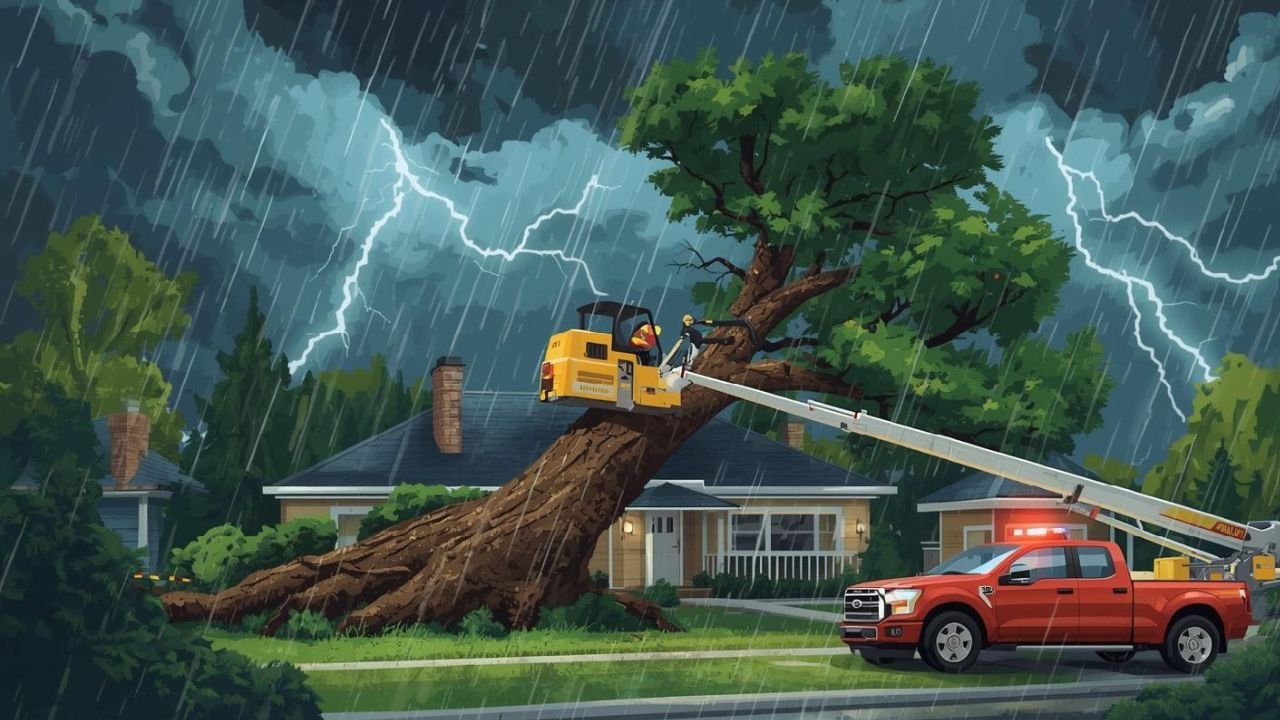
Storms are the most common trigger for Emergency tree cutting. High winds, heavy rain,
saturated soil, ice, and lightning can weaken or uproot trees with little warning. Even healthy
trees can fail under extreme conditions, especially if the ground becomes waterlogged and roots
lose their grip.
A key issue is that storm-damaged trees do not always fall immediately. A cracked limb can
hang in place for days. A partially uprooted tree may stand until the next weather event. That
delayed danger is one reason Emergency tree cutting exists. It allows homeowners to reduce
risk before a follow-up storm turns damage into disaster.
After a storm, a prompt inspection is wise. If the tree is leaning, split, or dropping large limbs,
Emergency tree cutting may be the safest path. If damage is minor, targeted Tree cutting or
pruning may solve the issue without removal. The point is to make a decision based on risk, not
on guesswork.
Why Waiting Can Make Tree Emergencies Worse
Delaying action often increases risk. A tree that is already leaning, cracked, or uprooted can fall
during the next gust of wind or heavy rainfall. What could have been a controlled removal
becomes an uncontrolled collapse. In many cases, homeowners who wait end up needing more
extensive Emergency tree cutting after additional damage occurs.
Waiting can also increase costs. A tree that falls onto a roof may require structural repairs,
interior water mitigation, and temporary housing. A limb that crushes a vehicle creates a sudden
financial burden. Prompt Emergency tree cutting can prevent that chain reaction by removing
the hazard while conditions are still manageable.
There is also the insurance angle. Policies vary, but if a clear hazard is ignored and damage
occurs later, claims can become more complicated. Acting responsibly, documenting concerns,
and scheduling Emergency tree cutting when appropriate can help demonstrate that you took
reasonable steps to protect your property.
How Professionals Decide When Tree Cutting Is Necessary
Emergency tree professionals evaluate several factors before deciding on removal. They
assess root stability, trunk integrity, canopy weight distribution, proximity to structures, and the
likelihood of failure. Not every damaged tree is removed. Some trees can be stabilized or
reduced through selective Tree cutting that removes the risky limb while preserving the tree.
This judgment is what separates responsible Emergency tree cutting from unnecessary
removal. The goal is to reduce immediate danger with the least impact possible. Sometimes that
means taking down the whole tree. Other times it means careful sectional removal, reduction
pruning, or temporary stabilization until the tree can be addressed more fully.
The Emotional Side Of Emergency Tree Cutting
Homeowners often feel conflicted about removing trees, especially mature ones that have been
part of the property for years. That emotional connection is valid. Trees can represent
memories, shade for family gatherings, and the character of a neighborhood. Choosing
Emergency tree cutting can feel like losing something important.
It helps to remember that Emergency tree cutting decisions are rarely made lightly. When a tree
becomes a clear hazard, action is about protection, not convenience. In some cases, removing
one dangerous tree prevents broader loss, including damage to homes, injury to loved ones,
and harm to other healthy trees nearby. Responsible Tree cutting can be an act of care, even
when it feels difficult.
Final Thoughts
Emergency tree cutting is critical for property protection because it addresses real, immediate
dangers that cannot be ignored. Trees are invaluable and should be preserved whenever
possible, but there are moments when Tree cutting is the safest and most responsible option. A
leaning trunk, a split base, or a heavy limb over a roof is not a “wait and see” situation. It is a
risk that can turn into damage at any time.
By understanding the difference between routine Tree cutting and true Emergency tree cutting,
homeowners can protect their property, their loved ones, and their surrounding environment. In
the end, emergency action is not about choosing destruction. It is about choosing safety when it
matters most.
About the Author